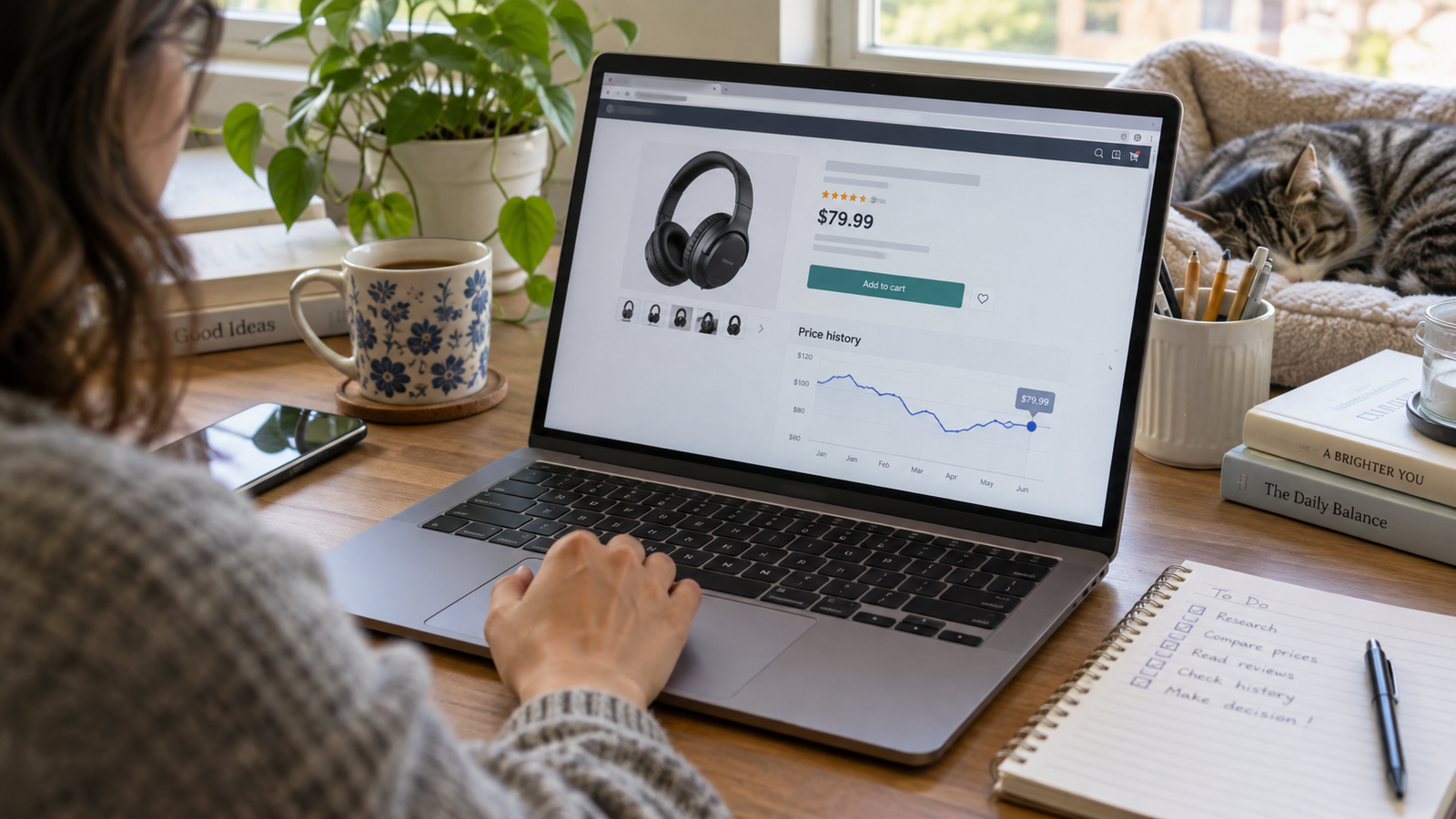
A big red “40% off” badge tells you one thing: Amazon is showing you 40% off something. It does not automatically tell you whether today’s price is actually good.
The useful number is not always the crossed-out price.
It is what the product normally costs.
Amazon prices move around. Coupons appear and disappear. Different colors can have different prices. Third-party sellers can take over the main offer. And a product that looks heavily discounted today may have sold for the same price three weeks ago.
Fortunately, checking an Amazon deal has become much easier.
Quick answer: Before buying an Amazon deal, check its recent price history, confirm the exact model or variation, compare the final checkout price with other retailers and make sure the seller and condition have not changed.
You do not need to spend 20 minutes researching a $12 phone charger. For expensive purchases, though, these checks can prevent a fake-looking bargain from becoming an expensive impulse buy.
Disclosure: Dabeast Deals participates in affiliate programs and may earn a commission from qualifying purchases at no additional cost to you.
How to check Amazon price history in 2026
Start on the Amazon product page itself.
Amazon now provides a native Price History view on many U.S. product pages. In 2026, Amazon says shoppers can see 30-, 90-, and 365-day price history directly from the product detail page or through Alexa for Shopping. Amazon’s current explanation of Price History confirms the feature now covers up to a full year of pricing context.
That native view is the fastest first check. If Price History is not available for the item you are viewing, third-party tools such as CamelCamelCamel and Keepa can still help you see how Amazon pricing has changed over time.
You do not need to obsess over finding the absolute lowest price the product has ever reached.
What you are really trying to answer is much simpler:
Is today’s price unusually good, pretty normal or actually worse than it looks?
The Dabeast 60-second Amazon deal check
When we look at a deal, these are the seven things that matter most.
1. Check what the product normally costs
This is the most important step.
Suppose Amazon shows:
List price: $99
Today: $59
Displayed discount: 40% off
That sounds excellent.
But if the item has spent most of the past three months between $58 and $65, then $59 is not really a once-a-year bargain. It is simply near its normal selling price.
On the other hand, if it normally sits around $85 and rarely falls below $70, then $59 deserves more attention.
The percentage badge is a clue. Price history gives it context.
2. Look at recent history before worrying about the all-time low
People love seeing the words “lowest price ever.”
But the all-time low can sometimes be one weird price drop that lasted a few hours a long time ago.
For a normal buying decision, recent history is often more useful.
Ask:
- What has this product normally cost during the last few months?
- How often does it fall to today’s price?
- Was it cheaper recently?
- Does the price drop every few weeks anyway?
If the same “special” price keeps returning, there is probably no need to panic-buy because a countdown timer appeared.
3. Make sure you are checking the exact same product
This sounds obvious until Amazon gives a product page twelve colors, four capacities and three generations.
The dramatic discount may apply to:
- one unpopular color
- the smallest storage capacity
- an older model
- a renewed version
- one specific size
- a different seller
Before comparing prices, confirm the model number, size, color, quantity and condition.
A cheaper version is not a better deal if it is not the version you actually wanted.
4. Check the seller and condition
Amazon combines offers from Amazon itself and marketplace sellers on product pages.
That means the price can change without the physical product changing.
Sold by
Ships from
Condition
A new item sold by one retailer should not automatically be compared with an open-box, renewed or used offer from somebody else.
For expensive purchases, also check the return policy and warranty situation before deciding that a slightly lower price is automatically better.
5. Check the real checkout price
Sometimes the best part of an Amazon deal is not included in the large number displayed at the top of the page.
There may be:
- a clip-on coupon — and if it vanishes before payment, see our Amazon coupon checkout guide
- a Prime-only discount
- a promotional code
- a Subscribe & Save discount
- a quantity discount
If a recurring Subscribe & Save delivery is higher than expected, see why your Amazon Subscribe & Save price changed before letting the next shipment process.
There can also be the opposite problem: the attractive price only applies to one seller, one quantity or one variation.
Before buying, look at the order total and make sure the promotion you expected actually applied.
The checkout number is the one your bank account cares about.
6. Compare another retailer before buying something expensive
An Amazon discount does not automatically mean Amazon has the lowest price.
For a $15 household item, comparing five stores is probably overkill.
For a laptop, television, vacuum, gaming console or expensive appliance, spending another minute checking competitors makes sense.
Search the exact model number rather than only the product name.
That prevents you from accidentally comparing different generations or configurations.
7. Ask the question deal pages cannot answer: do you actually need it?
A genuine 50% discount on something you never planned to buy is still money leaving your account.
This matters most during Prime Day, Black Friday and other large shopping events because thousands of products are competing for attention at the same time.
Try this rule:
If seeing the sale created the desire for the product, wait ten minutes before buying it.
If you were already looking for the exact item and the historical price is strong, that is different.
What does a genuinely good Amazon deal look like?
There is no universal percentage that makes something a good deal.
A 15% discount on a product that almost never goes on sale can be stronger than a “60% off” product that spends half the year at the sale price.
A strong deal usually has several things going for it at once:
- The current price is low compared with recent history
- The discount applies to the exact product you want
- The seller and condition are what you expect
- The final checkout price matches the advertised promotion
- Other major retailers are not significantly cheaper
- You were already considering buying the item
The more of those boxes it checks, the more meaningful the deal becomes.
Should you wait for Prime Day or Black Friday?
Not automatically.
Major shopping events produce plenty of real discounts, but they also produce an enormous amount of noise.
If a product is already near the bottom of its recent price range and you need it now, waiting several weeks to maybe save another few dollars may not make sense.
If the current price is ordinary and a major sale is only a few weeks away, waiting becomes more reasonable.
The important thing is that you are making the decision from actual pricing context rather than from the size of a sale badge.
Shopping on Amazon anyway?
If you are not already a Prime member, you can check Amazon’s current Prime offer. Eligible students can also check the current Prime Student offer.
Affiliate links. We may earn from qualifying sign-ups.
For this year’s fall event, see our Amazon Prime Big Deal Days 2026 guide.
What about CamelCamelCamel and Keepa?
Both are commonly used Amazon price-history tools.
CamelCamelCamel is straightforward if you mainly want to paste an Amazon product link and see how its price has changed.
Keepa offers more detailed charts and tracking information for shoppers who want to dig deeper.
Amazon’s own price-history information may be enough for a quick check when it is available.
The important part is not which tool you choose.
The habit is what matters: check the price before trusting the discount.
Three things we would not use as proof that a deal is good
A giant percentage-off badge
Useful for getting your attention. Not enough information by itself.
A countdown timer
A timer tells you when the offer may end. It does not tell you whether the offer is historically unusual.
The words “limited-time deal”
Again, that describes the promotion. It does not replace price history.
How Dabeast Deals thinks about a deal
We would rather show a smaller real discount than a giant percentage that does not mean much.
When judging deals, context matters: what the product normally sells for, whether the current offer is actually lower and whether the product itself is worth buying.
You can read more about our approach on How We Find Deals.
For current price drops, browse the Dabeast Deals live feed.
Frequently asked questions
Can you check Amazon price history?
Yes. Amazon provides price-history information for some products, and third-party tools such as CamelCamelCamel and Keepa can also help shoppers view historical Amazon pricing.
How can I tell if an Amazon deal is actually good?
Compare today’s price with its recent price history, confirm the exact model and seller, check any coupon or promotion at checkout and compare expensive products with another retailer.
Is the Amazon list price the normal price?
Not necessarily. A list or reference price can provide context, but it should not automatically be treated as proof of what shoppers have recently been paying. Recent price history gives you a better view of the product’s normal selling range.
Is the lowest-ever Amazon price always the best time to buy?
No. An all-time low may have been brief or may never return. A current price near the normal low end of the recent range can still be a strong deal if you actually need the product.
Should I wait for Prime Day to buy something on Amazon?
It depends on the current price, how urgently you need the item and how often the product goes on sale. If today’s price is ordinary and Prime Day is close, waiting can make sense. If it is already unusually low, waiting does not guarantee a better price.
The bottom line
You do not need to become a professional deal hunter.
You just need one habit:
Check what the product normally costs before getting excited about how much Amazon says you are saving.
For cheap everyday purchases, that might take ten seconds.
For expensive purchases, add a seller check and a quick comparison with another retailer.
That is usually enough to separate a genuinely good price from a deal that simply has very enthusiastic formatting.
If you want something more fun to browse after all that responsible shopping, see our 12 Amazon home finds that solve annoying everyday problems or our 15 small-space Amazon home finds under $25.
Affiliate disclosure: Dabeast Deals may earn from qualifying purchases made through affiliate links at no additional cost to you. Prices and availability can change.